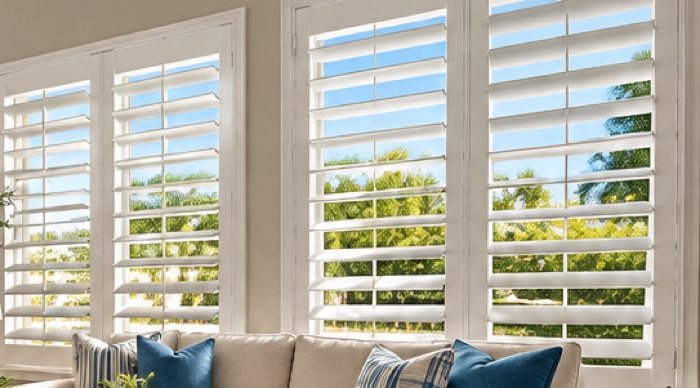
Blinds and plantation shutters do the same job — control light, provide privacy, cover a window — but they do it with very different lifespans, maintenance, and presence in a room. Here's how they compare across the dimensions that actually matter to a homeowner, scored honestly.
Head-to-head
| Category | Plantation Shutters | Blinds |
|---|---|---|
| Light control | Excellent — 3.5" louvers tilt precisely; 50/50 split lets you open top for light while keeping bottom closed for privacy | Good — slats tilt, but thinner slats and headrail gaps leak more light around edges |
| Privacy | Excellent — louvers close flat and the frame seals the opening with minimal gaps | Good — decent when closed, but cord holes, ladders, and edge gaps compromise it |
| Durability | 15–20+ years typical — rigid panels, no cords to snap, no slats to bend | 3–7 years typical — slats bend and yellow, cords fray and snap, mechanisms fail |
| Cleaning | Wipe with a damp cloth — wide flat louvers, no cords or ladders trapping dust | Dust slat by slat — cords, ladders, and thin slats make it slow and fiddly |
| Kids & pets | Cordless by design — no strangulation hazard, nothing for cats to bat around | Corded blinds are a documented child hazard; pets destroy slats quickly |
| Home value perception | Strong — buyers notice shutters; agents list them as a feature | Neutral — expected, not remarked upon; cheap blinds can read as 'needs updating' |
| Upfront cost | Higher — from $18.95/sq. ft. plus $200 flat delivery per order | Lower — the cheapest way to cover a window, by far |
| Cost over 15 years | Usually lower — buy once vs. replacing blinds 2–3 times | Adds up — two or three full replacements plus the hassle each time |
Where shutters clearly win
Durability and cost over time. This is the heavyweight argument. A set of plantation shutters lasts 15–20+ years with occasional wiping. In that same span, most homeowners replace blinds two or three times — slats bend, cords snap, mechanisms jam, white plastic yellows. Add up two or three full-house blind replacements, plus the Saturday mornings spent installing them, and the "cheap" option stops looking cheap.
Cleaning. Anyone who has dusted a full house of blinds knows the pain: slat by slat, both sides, around cords and ladders. Shutters are wide, flat, rigid louvers — a damp cloth, a few passes, done. In kitchens and bathrooms, where grease and humidity punish fabric and wood blinds, the difference is even starker.
Kids and pets. Corded blinds are a well-documented strangulation hazard for small children — it's why cordless has become the standard recommendation. Our shutters are cordless by design, with the tilt gear hidden in the stile: nothing to wrap, nothing for a cat to turn into a toy, no slats for a dog's nose to bend.
Home value perception. Ask any listing agent: plantation shutters photograph beautifully and buyers comment on them. They're one of the few window treatments that read as an upgrade rather than a placeholder. Blinds, even nice ones, read as expected — and cheap blinds read as "needs updating."
Where blinds honestly win
Upfront cost. No contest — blinds are the cheapest way to cover a window, full stop. If the budget is tight right now, blinds today beat bare windows while you save for shutters.
Rentals and short-term situations. Landlords, house-flippers on a clock, and anyone selling within a year or two should think twice about shutters. Blinds are cheap, fast, and you won't grieve when a tenant destroys them.
Odd windows. Arches, circles, trapezoids, and extreme sizes that fall outside standard RS sizes are hard for any standard-size program. Custom blinds or custom shutters are the answer there — and that's a genuine limitation of the factory-built model worth knowing before you measure.
The bottom line
If you own your home and plan to stay, shutters win on nearly every axis that matters over a decade: durability, cleaning, safety, light control, and how the house feels and photographs. If you're renting, flipping, or covering windows on a shoestring this month, blinds are the rational choice — and there's no shame in it.
The DIY model changes the math further in shutters' favor: from $18.95 per square foot plus a flat $200 delivery per order, installed by you in a weekend, with most shutters delivered in as little as 48 hours. The traditional objection to shutters was never the product — it was the price and the 6–8 week wait. Remove those, and the comparison gets short.
- Own your home and staying 5+ years → shutters, it's not close
- Kids or pets in the house → cordless shutters for safety alone
- Selling within a year or renting it out → blinds are the rational pick
- Tight budget this month → blinds now, shutters when ready — bare windows help nobody
- Odd-shaped windows outside standard sizes → custom is the honest answer either way
Shutters vs blinds questions, answered
It depends on your time horizon. Over 10–15 years, shutters typically win on total cost because blinds get replaced two or three times in that span while shutters keep going. If you're selling next year, the math is closer — though shutters photograph better in a listing.
Decided on shutters?
Measure your windows with our measuring guide, match them on the size chart, and order — from $18.95/sq. ft. plus $200 flat delivery. Most shutters delivered in as little as 48 hours.