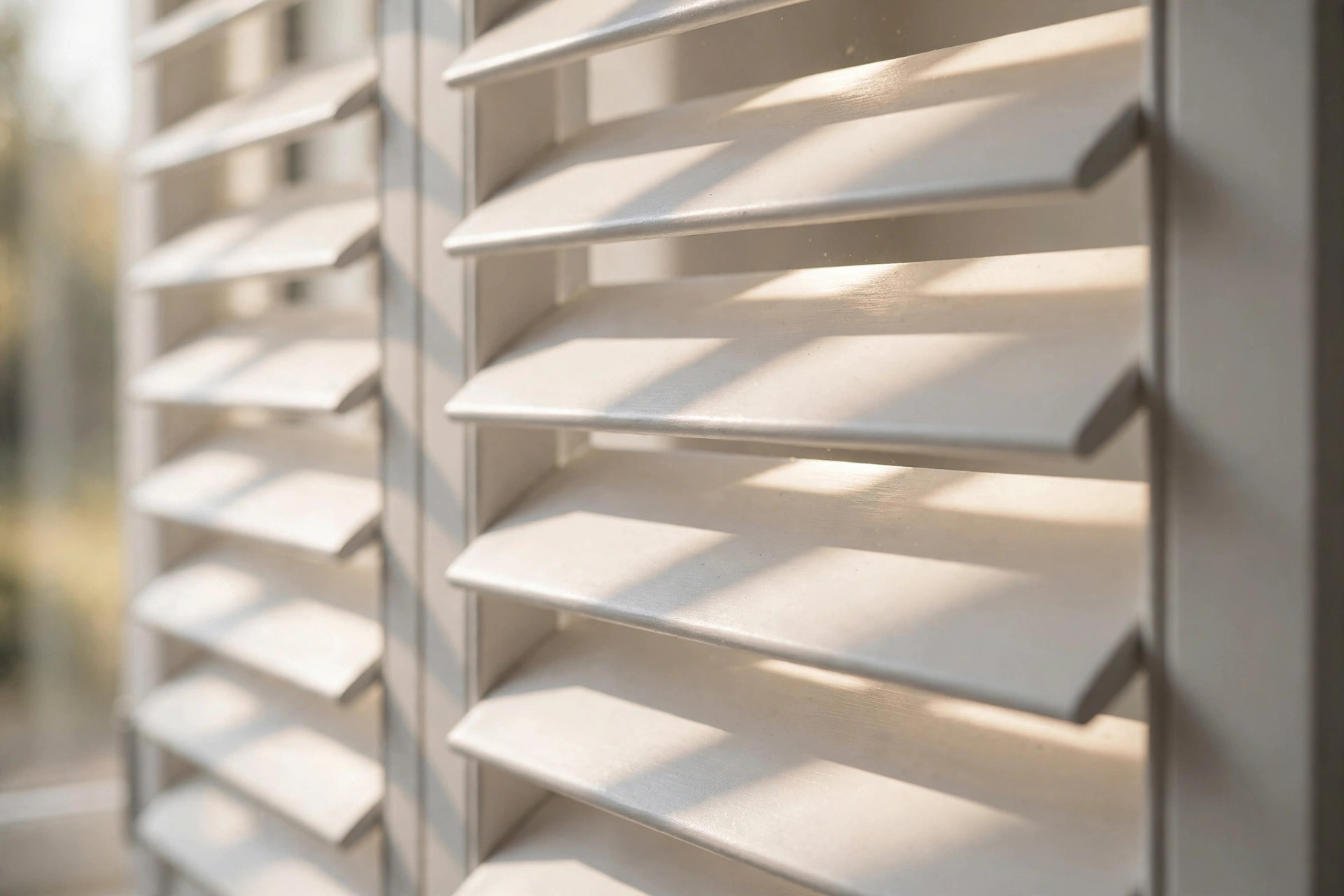
An inside mount sits within the window frame — recessed, tailored, with your trim still visible around it. An outside mount sits on the wall or trim around the window, overlapping the opening like a picture frame. Neither is universally better. The right choice depends on your window's depth, shape, hardware, and the look you want. Here's how to decide.
When inside mount works
Inside mount is the classic plantation shutter look — the shutter sits flush inside the frame, the louvers recessed, your casing and trim fully on display. It works when your window meets three conditions:
- Depth: at least 1-3/4 inches of clear, unobstructed depth from the front of the frame back — this is the hard minimum for our 3-inch flat Z-frame and 3.5-inch louvers
- Square: the opening is reasonably square — measure both diagonals, and if they differ by more than about 1/4 inch, reconsider
- Clear of hardware: no crank handles, tilt latches, or alarm sensors projecting into the frame where the louvers need to swing
Hit all three and inside mount is your answer. The finished look is clean and built-in — the shutter reads as part of the architecture rather than something hung on the wall. In rooms with beautiful trim you want to show off, inside mount is almost always the right call.
When outside mount is the answer
Outside mount isn't a consolation prize — it's the correct engineering answer for a long list of real windows:
- Shallow windows: less than 1-3/4 inches of depth — common in older homes, some sliders, and windows where the frame sits nearly flush with the wall
- Out-of-square openings: the frame overlaps the wall, so crooked openings and uneven gaps disappear behind it
- Casement windows with crank handles: the shutter clears the hardware entirely instead of fighting it
- Damaged or ugly trim you want covered rather than showcased
- When you want the window to look bigger: an outside mount adds visual height and presence — a legitimate design trick for small windows
One more honest point: outside mount is more forgiving to measure and install. The overlap hides small measuring sins that an inside mount would expose. If you're nervous about your first DIY shutter project, there's no shame in choosing the forgiving option.
How they look different
Inside mount keeps the sightline tight to the glass. From the street, the shutters read as part of the window itself. From inside, your trim frames the shutter like a mat frames a photograph. It's the tailored suit of window treatments.
Outside mount makes a bolder statement. The 3-inch flat Z-frame sits proud of the wall, the shutter becomes a design feature rather than a recess, and the window appears larger than it is. In rooms with plain drywall returns and no trim to show off, outside mount often looks better than inside mount would.
Light and privacy are excellent with either mount — the 3.5-inch louvers, hidden gear tilt, and 50/50 split control work identically. The difference is purely architectural: recessed and trim-forward, or overlapping and bold.
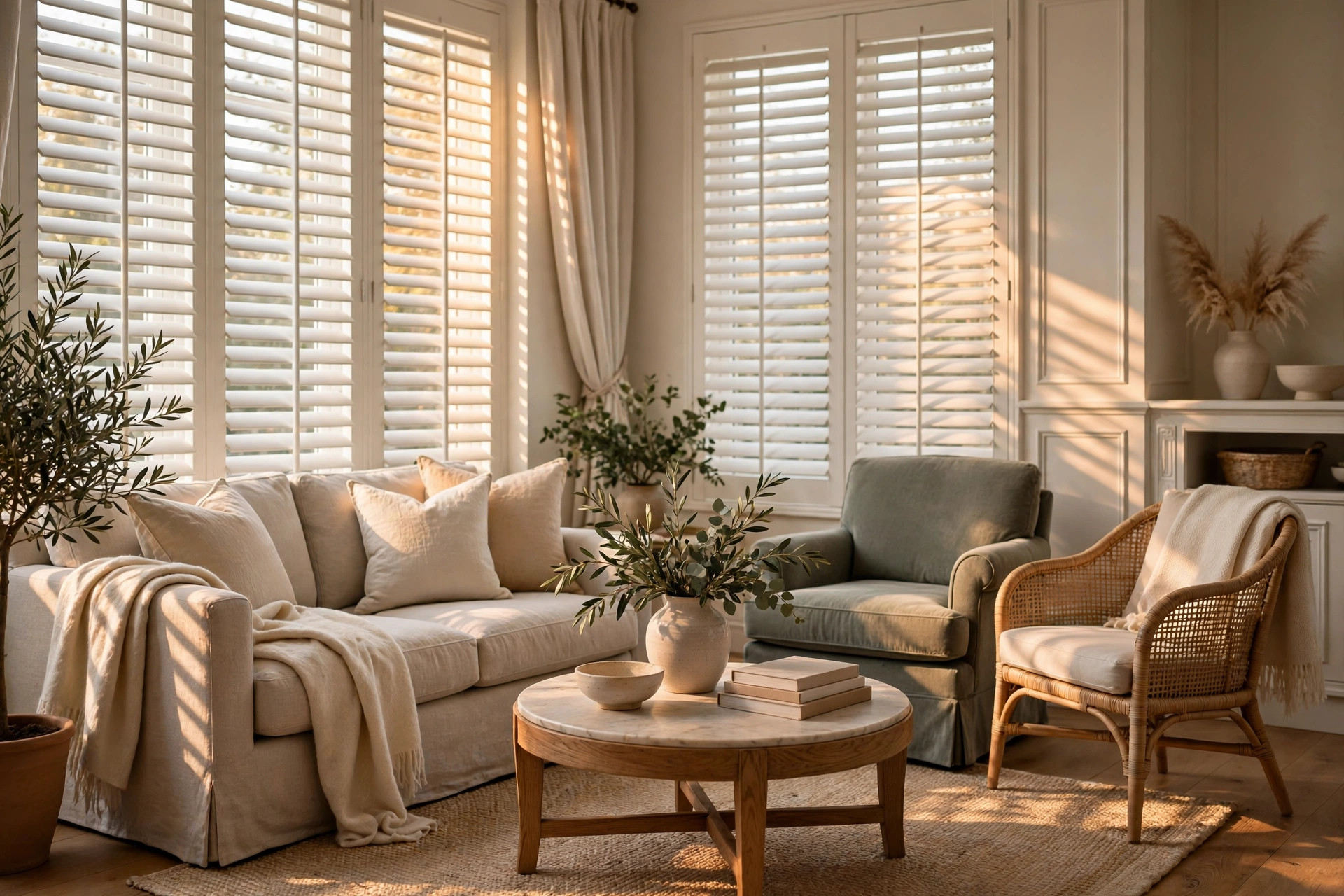
Measuring: it's different for each
This is where people get burned: the two mounts are measured completely differently, and you must decide the mount before you pick up the tape.
Inside mount measuring: measure the opening itself, jamb to jamb, at three points across the width (top, middle, bottom) and three points down the height (left, center, right). Record the smallest width and smallest height, round down to the nearest 1/8 inch, and match to the closest RS size on the size chart. Measure depth too — confirm your 1-3/4 inches.
Outside mount measuring: measure the opening, then decide your coverage — how far past the opening the shutter should extend on each side and top/bottom. A common rule of thumb is 2–3 inches of overlap per side so the frame fully covers the opening with margin. Add that overlap to your opening dimensions, then choose the RS size that covers your total. You're sizing to the finished coverage area, not the glass.
Our how-to-measure page walks through both methods step by step, and the 7 measuring mistakes guide covers the errors that sink most orders.
The quick decision tree
- Less than 1-3/4" depth → outside mount, no debate
- Crank handles or projecting hardware → outside mount
- Out of square by more than ~1/4" on the diagonal → outside mount
- Deep, square, clear opening → inside mount for the classic recessed look
- Small window you want to look bigger → outside mount as a design choice
- Beautiful trim to show off → inside mount
- Still unsure → outside mount is the forgiving default
Mount questions, answered
You need at least 1-3/4 inches of clear, unobstructed depth inside the window frame. That gives the 3-inch flat Z-frame and the 3.5-inch louvers room to sit and operate without hitting the glass or a crank handle.
Know your mount? Pick your sizes.
Match each window to its factory-built RS size on the size chart — from $18.95/sq. ft. plus a flat $200 delivery per order. Most shutters delivered in as little as 48 hours.