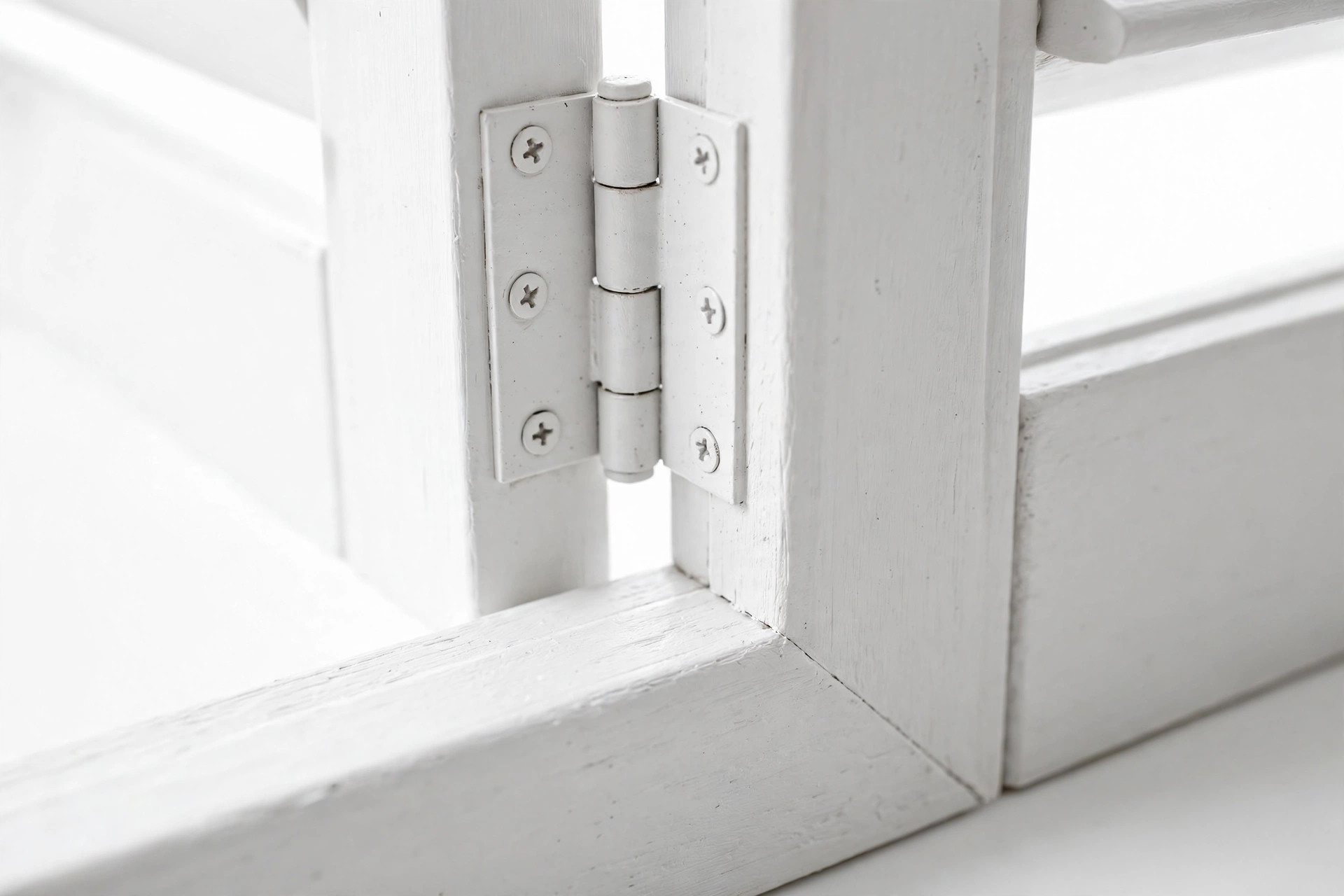
Here's the honest truth about DIY plantation shutters: the shutters themselves are factory-built to exact standard sizes, and the installation is a screw gun and a level. The only part of the whole project where things go wrong is the measuring — and it's almost always one of these seven mistakes. Read them once, measure once, and your order fits the first time.
1. Measuring the trim, not the opening
This is the single most common error. People run the tape across the decorative casing around the window and write down a number that's two or three inches wider than the actual opening.
For an inside mount, the shutter lives inside the window frame — so measure jamb to jamb, inside the frame, at three points: top, middle, and bottom. The trim around the window has nothing to do with the fit, so ignore it completely.
2. Taking one measurement per window
Windows are almost never perfectly square, especially in older homes or new construction that's still settling. One measurement across the middle tells you almost nothing.
Take three width measurements (top, middle, bottom) and three height measurements (left, center, right). Record the smallest width and the smallest height. A shutter sized to the narrowest point fits at every point in the opening; a shutter sized to the widest point binds or won't go in at all.
3. Mixing up width and height
It sounds impossible until you do it at 9pm in a dim bedroom. Width always comes first, then height — W × H, every time, no exceptions.
Write them down immediately as a pair (for example, 35-1/4" W × 58-1/2" H) and label every window as you go: "master bedroom left," "kitchen sink," and so on. A height number entered as a width produces a shutter that is spectacularly wrong in both directions.
4. Forgetting the depth
Width and height get all the attention, but depth decides whether an inside mount is even possible. You need at least 1-3/4 inches of clear, unobstructed depth inside the frame for the shutter's 3-inch Z-frame and louver clearance.
Measure from the front edge of the frame straight back to the glass or the nearest obstruction — and watch for window cranks, tilt latches, and alarm sensors that eat into that depth. If you're short of 1-3/4", don't force it: an outside mount is the right answer, not a shallower prayer.
5. Rounding the wrong way
When your tape lands between marks, never round up. A shutter that's a quarter inch too big doesn't fit; a shutter that's a quarter inch small still installs cleanly with the frame covering the gap.
Always round down to the nearest 1/8 inch, then match your opening to the RS size range on the size chart. Our shutters are factory-built in standard sizes — you're matching your opening to the closest standard size below your measurement, not ordering an exact-to-the-16th custom cut.
6. Measuring in the wrong unit — or mixing units
Grab an imperial tape measure and leave the metric side alone. Our entire size system — RS codes, dimensions, the size chart — is in inches, and converting back and forth is where transcription errors breed.
Same rule for fractions versus decimals: pick one notation and stick with it on every window. If your tape reads 35 and 3/8, write 35-3/8" — don't convert to 35.375" on one window and 35-3/8" on the next and hope you remember which was which.
7. Not checking whether the window is square
After your width and height measurements, measure both diagonals corner to corner. If the two diagonals differ by more than about a quarter inch, the opening is out of square — and an inside-mount shutter will show gaps or bind.
Slightly out of square is fine; the Z-frame covers small sins. Seriously out of square is your signal to go with an outside mount, where the frame overlaps the wall and the opening's imperfections hide behind it.
The pre-order measuring checklist
Run through this on every window before you order. It takes about ten minutes per window the first time, and half that once you've got the rhythm:
- Steel tape measure (not a cloth tailor's tape — it stretches), imperial units, 1/8-inch markings or finer
- A helper or painter's tape to hold the tape end — a sagging tape reads long
- Measure width at top, middle, and bottom — inside the jamb, ignoring trim. Record the smallest.
- Measure height at left, center, and right — inside the jamb. Record the smallest.
- Measure both diagonals corner to corner to check for square
- Measure depth from the front of the frame back — confirm at least 1-3/4 inches for an inside mount
- Note obstructions: cranks, tilt latches, alarm sensors, deep sills
- Round every measurement DOWN to the nearest 1/8 inch — never up
- Label every window (room + position) and record as W × H, width first, always
- Match each opening to an RS size on the size chart before you order
Inside mount or outside mount?
Your measurements decide this for you. If you've got 1-3/4 inches of depth, a reasonably square opening, and no crank handles in the way, an inside mount gives you that clean, recessed, built-in look with the trim still showing. Shallow frame, out-of-square opening, or cranks you don't want to fight? Outside mount — the frame overlaps the wall and hides all of it. Either way, measure for the mount you're actually doing; the two methods are different. Our inside vs outside mount guide walks through both, and the full how-to-measure page has the step-by-step with diagrams.
Measuring questions, answered
Inches, always. Our size chart, RS codes, and every dimension on this site are in inches. Picking up a metric tape measure is one of the most common ways a measurement goes wrong, so grab an imperial tape and keep one unit all the way through.
Measured twice? Order once.
Match each opening to its RS size on the size chart, then build your order — from $18.95/sq. ft. plus a flat $200 delivery per order. Most shutters delivered in as little as 48 hours.